

Picking the right NDIS living arrangement is one of the biggest decisions a participant or their family will ever make. There are so many options on the table: SIL, SDA, ILO, STA, MTA, in-home support. Each one sounds a little different, but what do they actually mean? And more importantly, which one is the right fit for you or your loved one?
Here is the tough part. Getting this decision wrong does not just mean a bit of inconvenience. It can mean funding gaps, living somewhere that does not match your needs, or missing out on the level of care that would actually make a real difference in your day-to-day life. Many NDIS participants go into their plan reviews without really understanding how the sil vs others ndis living arrangement decision works. And then they end up in a situation that does not truly support their goals.
That is exactly why this guide exists. We are going to break down every major NDIS living arrangement in plain, simple language. By the time you finish reading, you will know what each option actually means, how they compare, and which one might be the right fit for your situation. Let us get into it.
What is Supported Independent Living (SIL) Under the NDIS?
Before we can talk about the sil vs others ndis living arrangement comparison, it helps to really understand what SIL actually is. And trust us, a lot of people get this wrong.
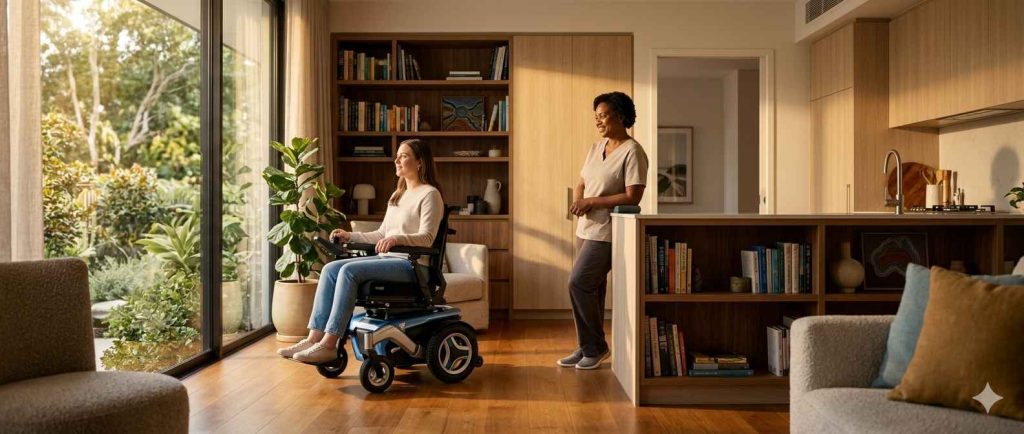
Supported Independent Living NDIS is a type of funding that pays for the daily support a person receives, not the house they live in. This is a really important distinction. SIL covers the help you get to go about your day, things like:
- Personal care, like getting dressed and grooming
- Cooking meals and managing the kitchen
- Taking medications at the right time
- Cleaning and household tasks
- Getting out into the community and social activities
Your SIL support workers are usually available around the clock, 24 hours a day, 7 days a week. They are there to help you live as independently as possible, not to do everything for you, but to support you in building skills and confidence along the way.
What SIL does not cover is just as important to understand. SIL funding does not pay for your rent, electricity, food, or furniture. Those are your personal living expenses. SIL NDIS is purely about the support you receive while you live in a home, whether that is a shared house with other NDIS participants or your own standalone place.
As a registered SIL provider Australia, Apex Support helps participants navigate exactly this kind of setup, making sure you know what your funding covers and what it does not before you make any big decisions.
SIL Funding Eligibility: Who Actually Qualifies?
Not every NDIS participant automatically gets SIL funding included in their plan. So before anything else, it is worth understanding who is actually eligible and how the approval process works.

To qualify for NDIS SIL funding, the NDIA generally looks at whether a person has significant daily functional impairment. That means they need regular, ongoing support just to manage everyday tasks like cooking, personal care, or getting around safely. It is not about how severe your diagnosis sounds on paper; it is about how your disability actually affects your daily functioning.
Here are some of the signs that SIL funding eligibility might apply to you or someone you care for:
- You need help with daily tasks like meals, hygiene, and medication consistently
- You require overnight or 24/7 support due to safety needs
- You are working toward building life skills and greater independence
- Living alone without support is not safe or practical for you
- You or your family need a structured, supported living environment
The process typically involves a functional assessment and a detailed SIL proposal put together by your support coordinator and the SIL provider. The NDIA reviews this proposal before approving funding, which is why having the right people in your corner matters a lot.
If you are not sure where to start, the Support Coordination team at Apex Support can walk you through the whole process, from assessing your eligibility to building a strong case for your plan review.
SIL vs SDA NDIS: Two Different Things That Often Work Together
This is probably the most common point of confusion in the whole sil vs others ndis living arrangement conversation. People hear SIL and SDA mentioned together all the time and assume they are the same thing. They are not.
Think of it this way. SDA is the house. SIL is the support inside the house. That is the simplest way to remember it.
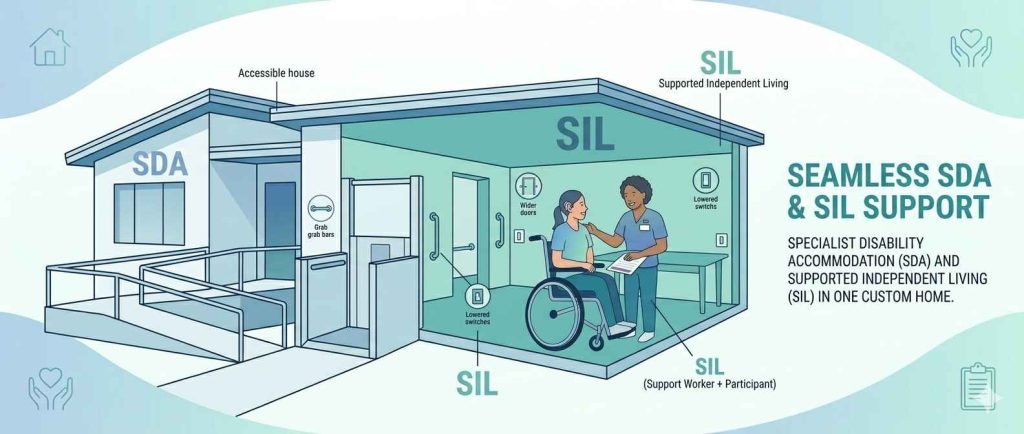
SIL vs SDA NDIS comes down to what each type of funding actually covers. SDA, or Specialist Disability Accommodation, pays for the physical building itself. These are purpose-built homes designed specifically for people with extreme functional impairment or very high support needs. The design might include wider doorways for wheelchairs, hospital-grade fixtures, or smart home technology for people with limited mobility.
SIL, on the other hand, funds the support delivered inside that home. So a participant can live in SDA housing and receive SIL support at the same time. They are funded separately but work together beautifully.
| Feature | SIL | SDA |
| What it funds | Daily support and care | The physical housing (building) |
| Who provides it | Registered SIL support workers | Registered SDA providers |
| Who qualifies | High daily support needs | Extreme functional impairment |
| Can be combined? | Yes, SIL and SDA work together | Yes |
| Approximate recipients | 35,000+ participants | Around 6,000 participants |
The key takeaway here is that SDA is for a much smaller group of participants, roughly 6,000 people compared to over 35,000 who receive SIL. You need to meet a very high threshold to qualify for SDA. But if you do qualify, combining SDA and SIL gives you both a purpose-built accessible home and the daily support to live in it well.
SIL vs ILO NDIS: Which Model Gives You More Choice?
SIL vs ILO NDIS is a comparison that is coming up more and more as the NDIS evolves. And it is a really important one to understand, especially if you value flexibility and having more say in how your support is delivered.
ILO stands for Individualised Living Options. It is a newer model under the NDIS that focuses on how you live, rather than where you live. Unlike SIL, which tends to follow a more structured, provider-led setup, ILO is co-designed with the participant. That means you get to have a bigger say in shaping what your support looks like day to day.
ILO can look quite different depending on the person. Some people use it to get support in their own home. Others might use it to live with a host family or a trusted person. The support arrangement is built around your individual goals and lifestyle, rather than fitting you into a fixed model.
SIL tends to work well when:
- You need high-level support around the clock
- You require consistent overnight care or active supervision
- A structured environment with a regular support team suits you
- You are moving out of home for the first time and want a steady routine
ILO tends to work well when:
- You want more control and flexibility over your support
- You value living in a setting that feels more personal and less institutional
- Your support needs are more moderate and do not require 24/7 staffing
- You want to live with a trusted person or in your own space with tailored help
It is also worth noting that ILO is still developing within the NDIS framework, so the availability of providers varies. Talking to your support coordinator is the best way to figure out whether ILO is a realistic option for your plan.
SIL vs In-Home Support: Do You Have to Move Out?
One of the biggest questions families ask is whether getting NDIS support means their loved one has to move out of the family home. The short answer is no, not necessarily. It depends on the type of support you choose.
In-home support is exactly what it sounds like. It brings NDIS-funded support directly to wherever you already live, whether that is your own home, a rental, or the family home you grew up in. Support workers come to you on a scheduled basis, helping with personal care, daily tasks, or community access, and then they leave. You stay in your space, in your routine.
SIL is different. It usually means moving into a supported living home, either a shared house with other participants or occasionally a standalone property. The support workers are there with you far more consistently, often around the clock.
| Feature | SIL | In-Home Support |
| Living Environment | Shared home with housemates | Your own or family home |
| Support Availability | 24/7 on-site care | Scheduled visits only |
| Social Setting | Built-in peer community | Existing family/social network |
| Privacy Level | Own room, shared spaces | Full privacy in your home |
| Best For | High and complex support needs | Intermittent support needs |
So who is better suited to in-home support? Generally, people who need occasional or scheduled help, who have strong family networks already in place, or who really value the privacy and familiarity of their own home. If a family member already provides a lot of informal care but just needs some extra professional help alongside that, in-home support often fits well.
SIL tends to suit people who need more intensive, ongoing support that would not be practical to deliver in a standard home setting. It also works really well for people who are ready for more independence and want to experience living in a community with peers.
Leaving home can feel like a big step. But many participants find that moving into a well-run SIL home actually builds their confidence faster than staying in an environment where everything is done for them. If you are searching for a reliable NDIS service near me, reaching out to a local SIL provider to tour a home and ask questions is a great first step.
SIL vs Short Term and Medium Term Accommodation: Is It Temporary or Long-Term?
Not everyone who enters NDIS housing is looking for a permanent arrangement right away. Sometimes you just need a short break, a trial, or a temporary place to stay while something more permanent gets sorted. That is where STA and MTA come in.
STA (Short Term Accommodation) is sometimes called respite care. It provides temporary housing and support for up to 14 days at a time. It is great for situations like:
- A family carer needs a short break from daily caring responsibilities
- A participant has just been discharged from hospital and needs temporary care
- Someone wants to trial what SIL living feels like before committing
- A person needs support while their usual home is being modified or repaired
MTA (Medium Term Accommodation) sits in between. It is designed as a bridge for participants who have been approved for long-term housing like SIL or SDA, but their permanent placement is not ready yet. MTA gives them somewhere stable and supportive to stay in the meantime.
SIL, by contrast, is a long-term model. It is not about a 2-week stay or a temporary fix. It is about building a life, learning skills, and having consistent support over months and years.
The journey often looks like this: a participant might try STA first to get a feel for supported living. If that goes well and their goals align, they might move into MTA while a permanent SIL home is arranged. Then once their NDIS SIL funding is confirmed and a home is ready, they transition into long-term SIL. It is a gradual, well-supported process.
Apex Support’s Respite Services can help participants and families explore short-term options as a stepping stone toward more permanent supported living.
SIL vs Others NDIS Living Arrangement: The Full Comparison at a Glance
Now that we have walked through each option in detail, here is the full sil vs others ndis living arrangement comparison laid out in one easy-to-read table. This can help you quickly see which option lines up with your situation.
| Option | Duration | Support Level | Housing | Best For |
| SIL | Long-term | High, often 24/7 | Shared/Standalone | Complex daily needs |
| SDA | Long-term | Varies | Specialist-built | Extreme impairment |
| ILO | Long-term | Flexible | Flexible | Choice and control |
| In-Home Support | Ongoing | Scheduled visits | Own/family home | Intermittent needs |
| STA | Short-term (14 days) | High | Temporary | Respite, trial stays |
| MTA | Medium-term | Varies | Temporary | Bridging placement |
Reading this table, you can see that there is no single option that beats the others. Each one exists because different people have different lives. A participant with very high support needs and complex care requirements will likely find SIL to be the best long-term fit. Someone with more moderate needs who values staying at home will suit in-home support much better. And someone still figuring things out might start with STA and work their way toward SIL over time.
The sil vs others ndis living arrangement decision is not one-size-fits-all. It is personal. And that is actually a good thing.
Not Sure Which NDIS Living Support Fits? Here is How to Decide
If you have read through everything above and are still not sure which arrangement is right for you, that is completely normal. These are big decisions, and there is a lot to think about. Here is a simple framework to help you work through it.
Ask yourself these four questions:
1. How much daily support do you need? If you need help with personal care, meals, and supervision throughout the day and night, SIL is likely the right fit. If you just need a few hours of help each week, in-home support makes more sense.
2. Do you want to stay in your current home or move somewhere new? If staying in a familiar environment matters to you or your family, in-home support keeps things stable. If moving to a more independent setting is the goal, SIL opens that door.
3. Do you value social connection or privacy more? SIL homes often have multiple residents, which creates a built-in social community. That is wonderful for some people and challenging for others. ILO might be a better fit if you want more control over who you live with.
4. Are you looking for something short-term or long-term? If this is a temporary situation, look at STA or MTA. If you are planning for the long haul, SIL or ILO is the way forward.
Your support coordinator plays a huge role in this process. They can help you weigh your options, prepare for plan reviews, and make sure your NDIS plan reflects what you actually need. If SIL funding eligibility is part of the picture, a good coordinator will help you build the strongest possible case.
It is also worth remembering that your living arrangement can change as your needs change. You are not locked into one option forever. Many participants start with in-home support or STA and transition into SIL as their goals and circumstances evolve. If you are looking for a trusted NDIS service near me, Apex Support serves participants across Melbourne and Hobart with a full range of living support options.
Looking for a Trusted SIL Provider in Australia? Apex Support is Here
Choosing a living arrangement is one thing. Finding the right team to support you through it is another. Apex Support is a registered NDIS provider offering a full range of services designed around real people and real goals.
Here is what the Apex Support team offers:
- Supported Independent Living: Long-term, person-centred SIL homes in Melbourne and Hobart
- Support Coordination: Expert help navigating your NDIS plan and finding the right services
- Respite Services: Short-term accommodation options for participants and carers who need a break
- Community Access: Support to get out, participate, and connect with the wider community
- Mental Health Support: Specialised care from qualified clinicians for participants with mental health needs
- Assist Life Stages and Transitions: Support through major life changes, including moving into SIL
Whether you are just starting to explore your options or you are ready to make a move, the Apex Support team is ready to listen. We can help you understand your options, request an NDIS SIL quote, and take the next step with confidence.
You do not have to figure this out alone. Reach out to Apex Support today and let us find the right fit together.
Finding Your Right NDIS Living Arrangement Starts with the Right Conversation
The sil vs others ndis living arrangement decision is not something you need to rush. It is one of the most personal choices a participant and their family will make, and it is okay to take the time to understand your options properly.
What we have covered in this guide is a lot of ground. From what supported independent living NDIS actually funds, to how it compares with SDA, ILO, in-home support, STA, and MTA. Each option has a place. Each one was created because real people have real, varied needs.
What matters most is not which option sounds most impressive. It is which option helps you or your loved one live a life that feels safe, fulfilling, and full of possibility. That is the whole point of the NDIS, and it is the whole point of finding the right living arrangement to go with it.
If you are ready to start that conversation, Apex Support is just a call away. Let us talk about what the right support looks like for you.
Frequently Asked Questions
1. What is the difference between SIL and SDA under the NDIS?
SIL funds the daily support a person receives, like help with personal care, meals, and household tasks. SDA funds the specialist-built housing itself. They serve different purposes but can be used together. A participant might live in an SDA property and receive SIL support inside that same home.
2. Who is eligible for SIL funding in Australia?
SIL funding eligibility is generally for NDIS participants who have significant daily functional impairment and need regular, ongoing support to manage everyday tasks. This is assessed through functional capacity evaluations and a SIL proposal submitted to the NDIA for approval.
3. Can I receive SIL support if I live in my own home?
Supported Independent Living NDIS is typically delivered in a shared or standalone supported living home rather than in a standard private residence. If you want support in your own home, in-home support or ILO may be more suitable options to explore with your support coordinator.
4. How is SIL different from ILO?
SIL vs ILO NDIS comes down to flexibility and structure. SIL is a provider-led model with consistent support, often 24/7, in a shared home. ILO is co-designed with the participant and offers more flexibility in how and where support is delivered. ILO suits those who want greater choice and control over their living arrangement.
5. How do I get an NDIS SIL quote?
To get an NDIS SIL quote, you will typically work with your chosen SIL provider and support coordinator. The provider assesses your support needs, prepares a detailed quote, and this is submitted to the NDIA for approval as part of your plan review. Apex Support can assist with this process from start to finish.
6. What do SIL support workers actually do day to day?
SIL support workers help participants with personal care, meal preparation, medication management, household tasks, and community participation. They are also there to encourage skill-building and independence, not just to do things for you, but to support you in learning to do more for yourself over time.
7. How long does it take to get NDIS SIL funding approved?
The NDIS SIL funding approval process can take several weeks to a few months, depending on the complexity of the participant’s needs and the quality of the SIL proposal submitted. Having a strong support coordinator and an experienced provider on your side can make the process faster and smoother.
8. How do I find a reliable NDIS service near me for SIL?
Start by searching the NDIS provider finder on the official NDIS website, or ask your support coordinator for recommendations. You can also contact a provider directly, like Apex Support, to ask about available SIL homes in your area, tour the properties, and ask questions before making any decisions.